In this article
I felt nostalgic for panchigi, a Korean coin-slapping game, and played it again after years away. Playing by myself turned out to be more trouble than I expected. I looked for a digital version on Google Play and elsewhere, but couldn’t find a panchigi game. So I decided to build one myself.
I wasn’t thinking about the screen first. I wanted to figure out how to make a coin flip because I had hit it with my hand.
Turning a downward swipe into a slap
The earliest physics-prototype commit I could verify in the repository is dated September 19, 2026. The game reads a swipe from top to bottom, then works out its speed and where it ends on the book. A swipe that is too short, too slow, or moving in the wrong direction doesn’t count as a hit. I also added mouse-drag input so I could test the same gesture on a PC.
The coins don’t get just one kind of push. An upward impulse lifts them and helps them flip. A weaker radial push sends each coin away from the impact point. When the hit lands away from a coin’s center, the offset adds rotation too. Together, those forces let hit strength and position change how the same setup plays out.
Letting movement become part of the rules
The physical motion wasn’t just there to make the game look lively. Once the coins could move, a coin falling off the book could become a real outcome in the round. A wonbbang—flipping all the target coins in one hit—could emerge from the hit and the physics instead of playing as a fixed animation. The first prototype didn’t have every mode yet, but the game later grew around a shared hit-and-physics layer, with each mode deciding what those results meant.
The first prototype also came with an end-to-end test suite with 47 checks, plus a tool for looking at balance. Tests could tell me whether the code ran and the rules connected; they couldn’t tell me whether a real person would enjoy the feel of the slap. That still took hands-on play and tuning.
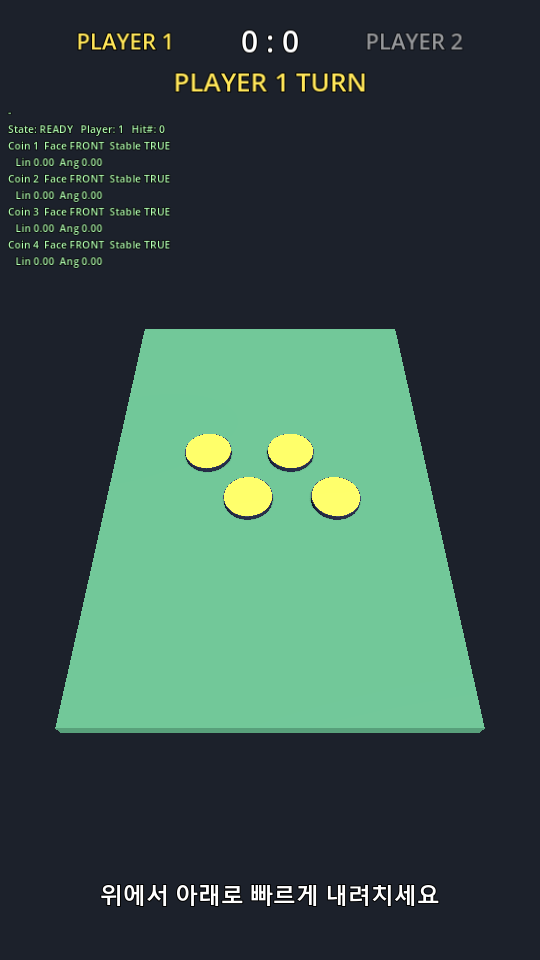
I ran commit 4c63c6d from September 19, 2026 again in Godot 4.7.2 to capture this. It is a reconstruction from the project files, not a screenshot saved at the time.
This time, I didn’t stop at launching the game. I sent the input code the same kind of gesture it was built to receive: a 350-pixel downward mouse swipe over about 0.11 seconds. The next three images show the game reacting to that input. I hid the debug numbers so the action would be easier to see; the hand effect and coin physics are still from the original code.
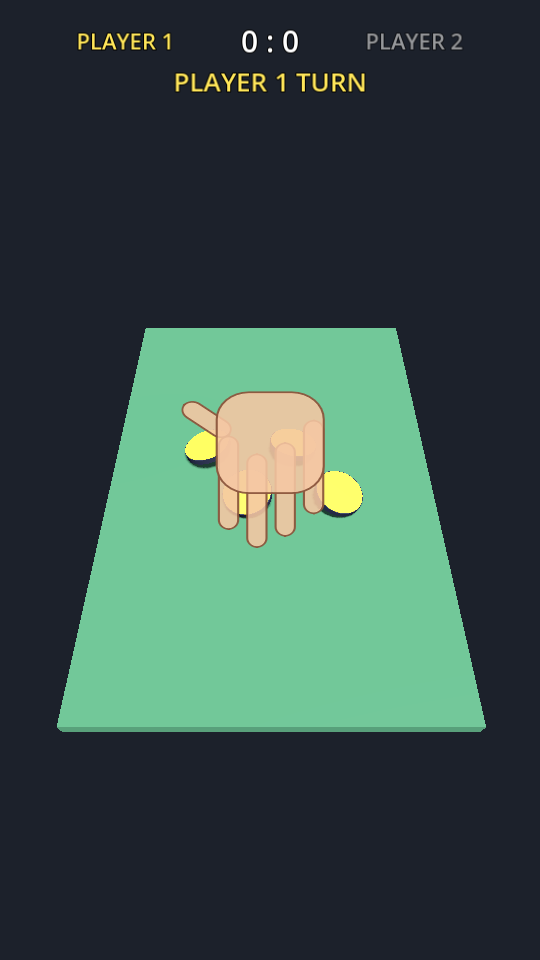
Right after the swipe, the hand effect comes down onto the board.
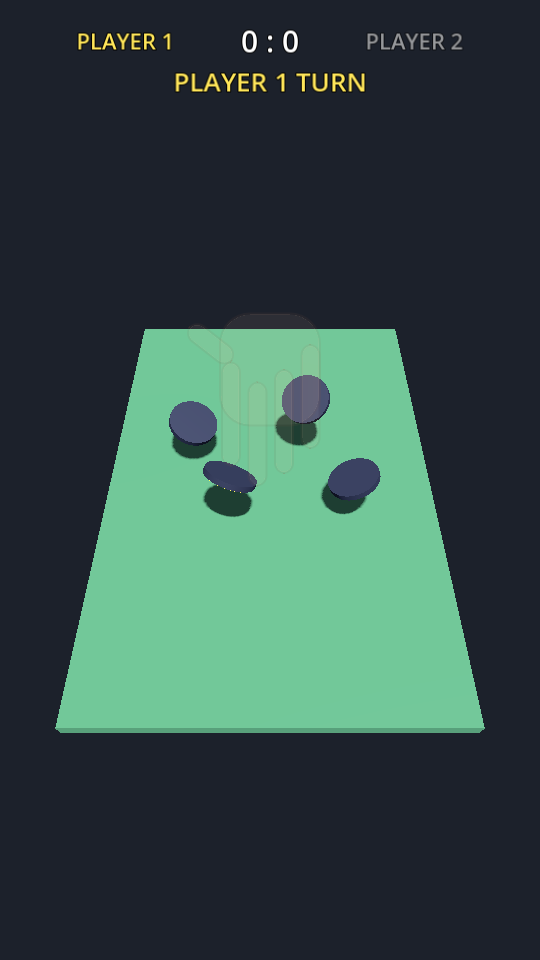
The coins flip and lift off after the hit, leaving their shadows on the board.
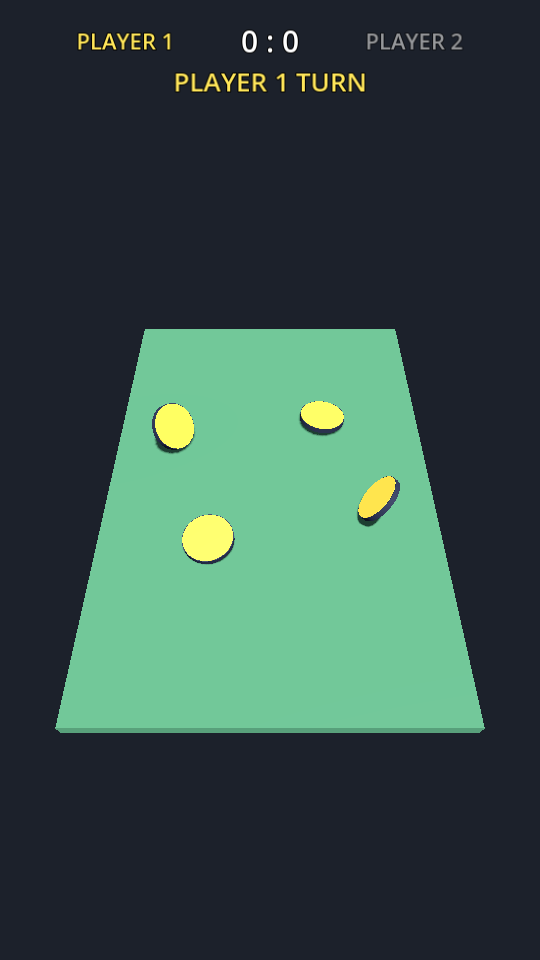
Even though the coins receive the same hit, they end up in different places and orientations. That difference was the start of the physical feel I wanted to build.
It’s easier to see how far the game came when I put that prototype next to a later stage.
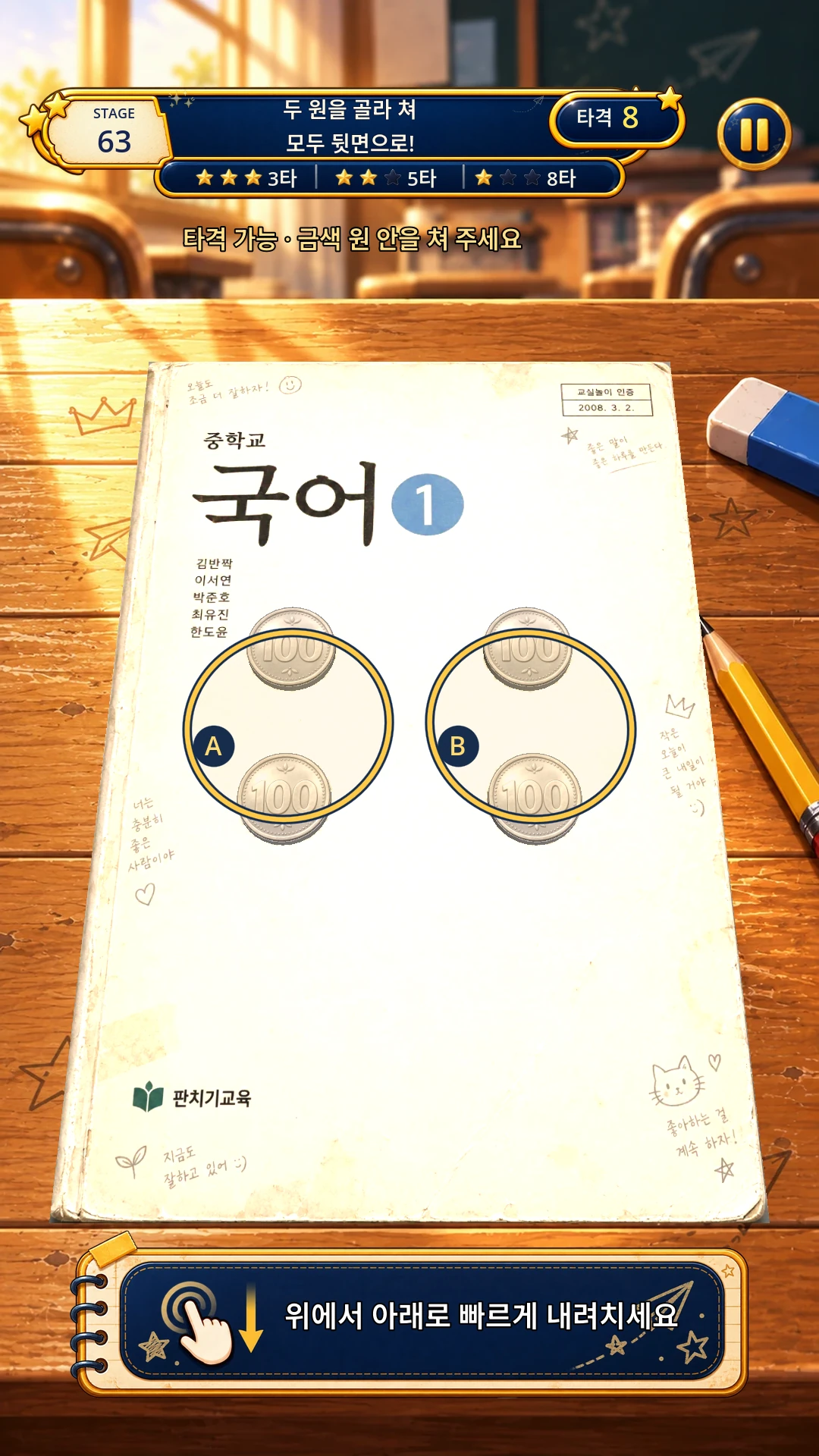
A later version of the game, after the first prototype.
Looking back, the first design question wasn’t really “How do I flip a coin?” It was “What movement makes this feel like panchigi?” Instead of deciding the answer as soon as the player tapped the screen, I started with physics so the hit could change with its strength and position.
But a coin didn’t only flip or fall off the book. Sometimes it stood on its edge for a while or rolled so slowly it looked almost still. In the next devlog, I’ll write about how I taught the game to judge those in-between moments.
Translation note: This English edition was adapted from the Korean original with AI assistance.
판치기
A mobile version of Korea’s coin-slapping game. Swipe to hit the book and flip the coins, with motion that responds to where and how hard you hit.
Explore the project (Korean) →
Join the conversation
Have a question or a different perspective? Leave a note.
Comments are in the works. You’ll be able to join the discussion here soon.